Visited April 2025
| Location | Stoke Park, Bristol |
| Entrance Fee | No |
| Railway Station Nearby | No |
| Parking | Yes- roadside |
| Facilities | None |
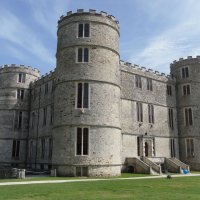
Ok, not a castle as such but definitely castle adjacent; an aircraft battery from WWII is a more modern answer to defending areas from attack- similar to the original purpose of a castle!


Review
Between 1940-41 the city of Bristol was facing onslaught after onslaught of German bombers. In order to defend the city a ring of anti -aircraft guns were positioned at various strategic places around the city to try to stop the bombers from reaching the city. The best surviving example of these is at Purdown, close to an area called Lockleaze.
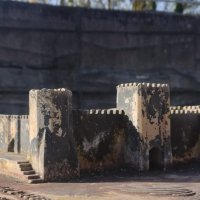
The gun enplacements at Purdown also had ammunition bays and shelters for the crew. These were soon joined by blast walls and a command post. Accomodation for the crew was also built alongside.
The guns only shot down two Luftwaffe aircraft in their time, but the firing of shells at the aircraft forced them to fly higher, making it harder for them to reach their targets. The guns were supposedly so loud, that the legend of Percy Purdown came about. Percy was supposedly a supergun used against the Luftwaffe. However it is unlikely that this supergun existed, but the noise that could be heard was due to the position of the guns up on a ridge, causing a massive boom that echoed around the area. Also, it is thought that several of the guns were fired simultaneously, further accounting for the racket.


Immediately after the war the building on the site were used to house families who had been made homeless by the bombing raids. In the 1960s the land was sold by the MOD and bought by the GPO, who used area of the accomodation blocks to build a telecommunications tower, which is still in use and forms part of the Bristol skyline to this day.
Today the remains of the battery are in pretty good condition and can be visited for free. They do get quite overgrown with brambles in the summer though, although the recent introduction of goats grazing in the near vicinity should help with this (the goats are super sweet and can be visited) The site is heavily graffitied but this adds to its feeling of faded glory. Once doing an essential job in the defence of what was to become the fifth most bombed city in Britain, the battery now rests silently in a large estate open to the public, known as Stoke Park.


The whole area of Stoke Park is a great place to visit with kids, with many walks available and views over the city of Bristol. There is a park run there on a Sunday which goes through the area next to the battery.
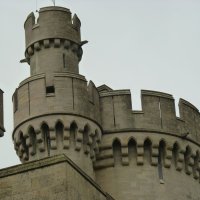
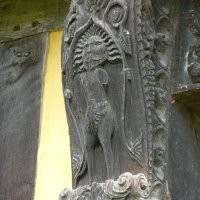
As well as the free-range goats, there are sometimes cattle grazing in the lower fields. There is also a large lake, known as Duchess Pond which is very popular with fishermen. There are wooden sculptures dotted around the park, and even a castle-like structure known as the Dower House- a yellow-coloured beacon of a building which can be seen for miles around. Sadly it is not open to the public as it is private housing, but the grounds of Stoke Park are all around it so anyone can walk past and view the exterior.
The one downside to visiting Stoke Park for us was the noise- the M32 motorway runs very close next to it and the traffic noise was constant and intrusive in a place which feels as though it should be more peaceful.
There is roadside parking all around the site, we parked on the road next to the entrance to Duchess Pond. There are no facilities there, but nearby Snuff Mills has toliets and a cafe in its car park, and is itself a lovely place to walk by the river.


More info: Stoke Park